
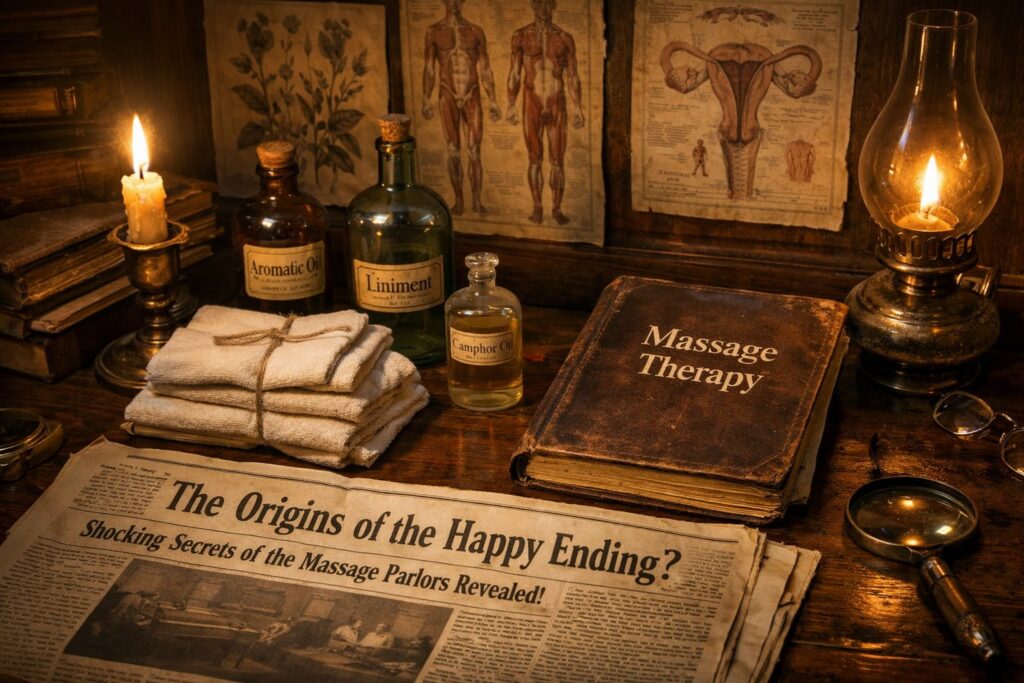
The real origins, the myths, and why the “first” is basically a mystery
If you’re Googling “Who invented the first happy ending massage,” you’re not alone. It’s one of those questions that feels like it should have a single dramatic answer, like, “It was invented in a candlelit bathhouse by a rogue healer in 312 BCE,” and then roll credits.
But the truth is more interesting, more human, and a little messier.
A “happy ending massage” is not one clean invention. It’s a modern label for something that likely evolved in pieces across time, across cultures, and across industries. Touch, massage, intimacy, taboo, commerce, medicine, and plain old curiosity all collide here.
So let’s do this the right way. No cringe, no fake certainty. Just a well researched, playful, professional look at what we actually know.
First, what does “happy ending” even mean, historically?
Here’s the fun twist. The phrase “happy ending,” as a euphemism for sexual release at the end of a massage, appears to be pretty modern.
Linguists and etymology nerds point to the Oxford English Dictionary’s earliest citation for “happy ending” in this specific euphemistic sense as late as 1999. That does not mean the behavior began in 1999. It means the popular slang label is newer than people assume.
Modern pop culture helped spread it in the 2000s, especially in the way people talk about massage parlors in travel contexts or late night humor.
So if you’re hunting the first “happy ending massage,” you’re asking two different questions:
- When did massage sometimes include sexual services?
- When did people start calling it a “happy ending”?
Those timelines are not the same.

The ancient world: massage, ritual, and sensuality were often neighbors
Massage is ancient. So is erotic art. So is the basic human realization that touch can be both healing and arousing.
Many societies had bathhouses, oiling rituals, fertility symbolism, and professional attendants who worked with the body. It would be shocking if sensual outcomes never happened. But here’s the historian’s headache: we rarely get clean documentation that says, “This service included sexual release as a standard add on.”
What we do have are long histories of massage as:
- medical and therapeutic care
- religious or ritual purification
- social bath culture
- courtly luxury and elite leisure
In other words, ancient cultures built environments where massage and sensuality could easily overlap, even if they were not always officially described as “sex work.” That ambiguity is part of the story.
The Victorian “hysteria” narrative: famous, fascinating, and… debated
Now we enter the part of the story that gets repeated everywhere online.
You’ve probably heard this version:
“Victorian doctors treated ‘female hysteria’ by massaging patients until they reached something called ‘hysterical paroxysm,’ then they invented vibrators to make it easier.”
There is a reason this story went viral. It is outrageous, it sounds plausible, and it makes modern people feel like they discovered a secret trapdoor under history.
Here’s what is factual:
- “Female hysteria” was indeed a real historical diagnosis used for a huge range of symptoms, and it has since been rejected by modern medicine.
- Vintage Vibrators did exist historically as medical or commercial devices, and by the early 1900s, some were marketed for home use in various “health” contexts.
Here’s what is heavily debated:
The specific claim that Victorian physicians routinely used vibrators to induce orgasm as a standard medical treatment is contested by historians. A prominent academic critique argues there is no solid evidence that this was a routine medical practice.
Even summaries of the topic now often include an explicit warning that the “doctors routinely used vibrators for hysteria” storyline may be an overgeneralization.
So what do we do with that?
We don’t throw it out entirely. We treat it like what it is: a debated historical claim that became a modern myth machine.
The honest takeaway is this:
Victorian era ideas about women’s bodies were often controlling, weirdly medicalized, and sometimes cruel. But the neat Hollywood plot of “doctors giving orgasms by prescription all day long” is not proven as a widespread routine.
Still, the hysteria conversation matters because it shows how easily pleasure and medicine have been mashed together in history, often without women being allowed to name what was actually happening.
So where does the modern “happy ending massage” likely come from?
If we’re talking about the modern commercial version people imagine today, the most evidence points toward the 20th century and the rise of “massage parlor” culture in major cities.
In the United States, massage parlors have been linked to prostitution since at least the 19th century, and the association became especially visible in the late 1960s and 1970s.
Academic and historical work on the industry describes the 1970s as a boom period for sexually oriented massage parlors, including marketing styles that leaned into the “exotic” or “erotic” vibe.
That era matters because it’s where the modern template starts to look familiar:
- a storefront that advertises massage
- an implied or coded offer of “extra”
- law enforcement crackdowns
- a cultural stereotype that spreads faster than the facts
This is also where language evolves. Terms get invented, reshaped, and repeated until they become “common knowledge,” even when they’re sloppy or unfair to legitimate massage therapy.
Who “invented” it, then?
If you want the most accurate answer, it’s this:
No single person invented the first happy ending massage.
It’s a convergence.
- Massage is ancient and universal.
- Sex work is ancient and universal.
- Markets create menus, euphemisms, and add ons.
- Pop culture then slaps a catchy phrase on it and makes it feel like one defined thing.
The phrase “happy ending” as slang appears fairly recent, but the behavior it points to likely existed in different forms long before it had that name.
Curious about more history on happy endings? Read the full History Guide!
What probably happened during the “first” one?
Here’s the most realistic scenario, and it’s less cinematic but more believable:
A massage happened. Someone got aroused. Someone noticed. The moment turned intimate. Then it either became a repeated expectation, a negotiated service, or an occasional outcome.
That is how many human practices begin, especially the taboo ones. Not as an invention, but as a pattern.
If you were hoping for a single birthplace, like “It started in Bangkok” or “It started in ancient Rome,” be careful. Those claims are usually stereotypes or tourism mythology, not clean historical fact. What we can say is that the modern commercial stereotype spread globally over time, and the slang itself became widely recognized in recent decades.
A quick respectful note about modern reality
There’s also a serious side to this topic.
Many illicit massage businesses today are tied to exploitation and trafficking. That’s part of why modern reporting and law enforcement actions around “massage parlors” are often framed as public safety and human trafficking concerns.
That doesn’t mean massage is shady. Legit massage therapy is real healthcare. It means the gray market version of this topic can overlap with harm, which is worth acknowledging.
The modern, consensual fantasy version
Now for the part most readers actually care about.
In consensual adult fantasy, the “happy ending massage” represents a specific vibe:
- relaxation that turns electric
- slow teasing that stays playful
- permission, trust, and escalation
- the feeling of being cared for, then desired
If you’re exploring this in your own life, the best version is always the one that’s ethical and enthusiastic. Communication, consent, and intention matter more than any “technique.”
FAQ
Where was the first happy ending massage?
There’s no verified single location. Massage is ancient, and sexual commerce is ancient. The modern commercial “massage parlor plus extras” template is most clearly documented in 20th century urban contexts.
Did Victorian doctors really do this as medicine?
The hysteria diagnosis is real history, and vibrators existed, but the claim that doctors routinely used vibrators to induce orgasm as a standard treatment is strongly disputed by historians.
When did the term “happy ending” start meaning this?
The euphemistic slang sense appears to be late, with OED citations commonly referenced around 1999.